
# AC Not Cooling in the Saudi Summer? Here’s What’s Actually Wrong
It’s 2pm. Outside it’s touching 46 degrees, the tiles are hot through your slippers, and your AC is running — you can hear it — but the air coming out is just… warm. Room-temperature warm. If that’s you right now, I get it. This is the single most common call I take between June and September, and half the time the fix costs you nothing.
So before you panic and book anyone, let’s go through it the way I would if you rang me. Some of this you can sort out yourself in five minutes. Some of it you shouldn’t touch. I’ll tell you which is which.
First, the five-minute checks anyone can do
Start here. Honestly, a good number of “AC not cooling in summer” jobs I get called out for turn out to be one of these four things, and you’d have saved yourself a call-out fee.
The thermostat. Sounds stupid. It isn’t. Check it’s on cool, not fan. Fan mode just blows air around — no cooling at all, and it feels exactly like a broken AC. Set the target a few degrees below the room temperature and listen for the compressor kicking in.
The breaker. Go to your distribution board. Is the AC’s breaker fully on, or has it tripped halfway? A half-tripped breaker can leave the indoor fan running while the outdoor compressor gets no power — warm air, basically. Flip it fully off, wait, flip it on. If it trips again straight away, stop. That one’s for me, and I’ll explain why below.
The filter. Pull the front cover off the indoor unit and look at the mesh filter. In Jeddah especially — the dust plus that sticky coastal humidity off the Red Sea — these clog fast — I’ve pulled filters that were more grey felt than filter. A blocked filter chokes the airflow and the unit can’t cool. Rinse it under the tap, let it dry, put it back. Do this monthly in summer and you’ll avoid a lot of grief.
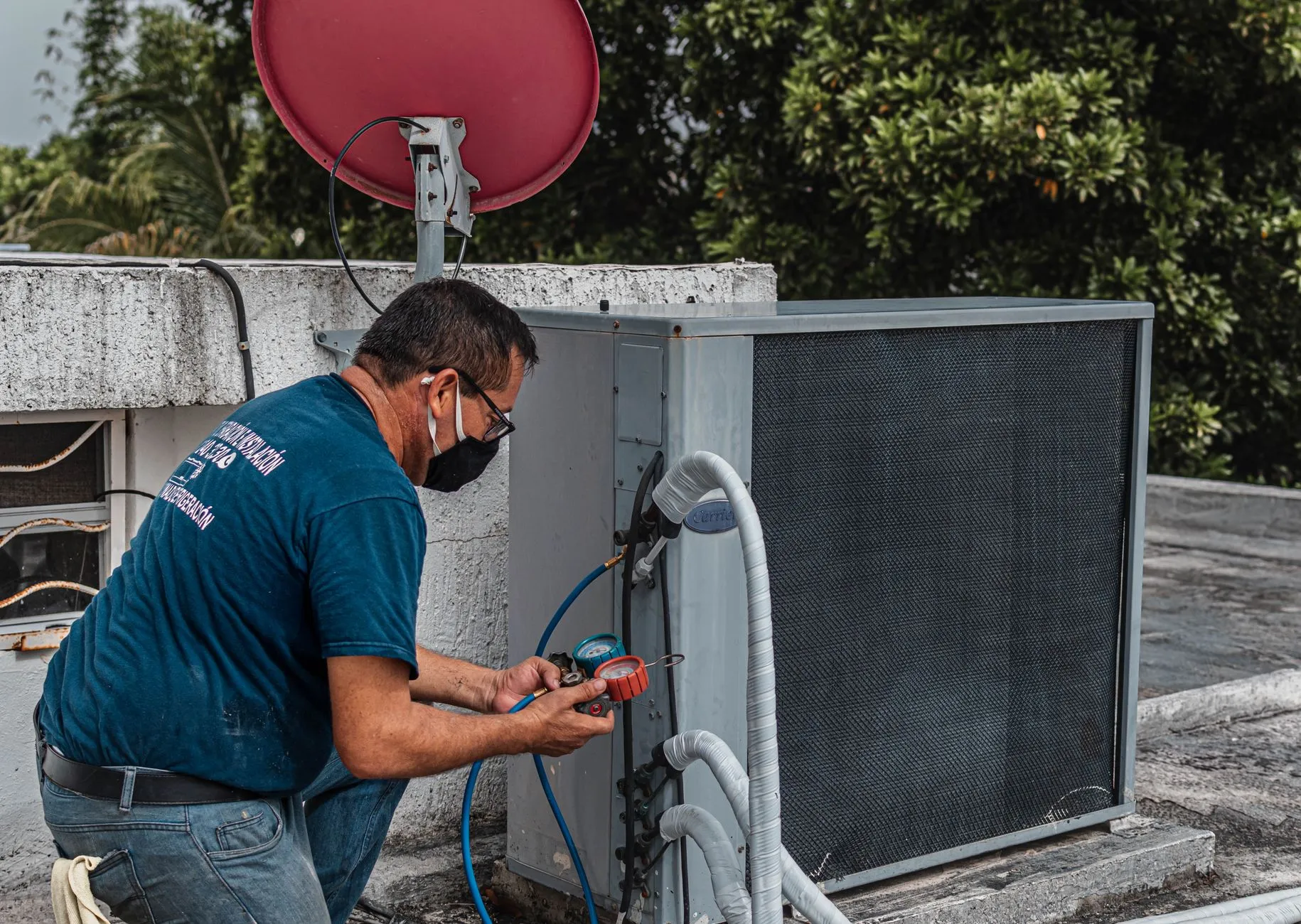
The outdoor unit. Walk around and look at the condenser box outside. Is the fan spinning? Is it caked in dust, or has someone stacked boxes against it? These units breathe out heat, and if they can’t, cooling drops off a cliff. Give it space and a gentle hose-down.
If one of those was the culprit — great. Close the tab and go enjoy your cold room.
When it’s not the AC, it’s the electrics
Here’s where it gets more serious, and where my actual job starts. Some symptoms aren’t a lazy compressor or a dirty filter. They’re electrical, and a few of them are genuinely dangerous.
Call it in — don’t poke at it — if you see any of these:
- The breaker trips the instant you switch the AC on, every time. That’s a short or an overload, not a coincidence.
- A burning or fishy plastic smell near the unit or the socket. Stop using it. That smell is usually overheating wiring or a failing capacitor.
- Scorch marks or discolouration on the plug, socket, or isolator switch.
- The unit is completely dead — no fan, no lights, nothing — but other things on that circuit work.
- Lights dim or flicker every time the AC cycles on.
I had a villa in Jeddah last summer where the family thought their AC was dying. It wasn’t. The isolator switch behind it had half-melted from years of heat and a loose connection, and it was one bad day away from being a real fire risk. The AC was fine. The wiring nearly wasn’t. You cannot see that from the front, and you definitely shouldn’t be opening it yourself.
Why our summers are so hard on these units
There’s a reason this problem spikes here specifically, and it’s worth understanding.
Think about the load. When it’s 45-plus outside and you want 22 inside, your AC is fighting a 23-degree gap for ten, twelve hours straight. That’s brutal on a compressor. Add the dust — which coats the outdoor coils and acts like a blanket, trapping the heat the unit is trying to dump — and, here on the coast, the salty humid air that quietly eats away at the metal year after year, and you’ve got a machine working at its limit on a bad day.
Then there’s the power side. Voltage here isn’t always as steady as you’d like, and big swings are hard on compressor motors and capacitors. That’s why I tell people a decent stabiliser is cheap insurance for an expensive split unit. Not glamorous advice. Just true.
What a technician actually checks
So you’ve called someone out. What are they doing, beyond looking knowledgeable?
A proper visit means measuring, not guessing. I check the voltage at the unit under load, test the capacitor (a weak capacitor is probably the number-one reason a compressor hums but won’t start), check the contactor, and read the current the compressor is pulling against what it’s rated for. I’ll look at the isolator and the wiring for heat damage. Refrigerant gas, I’ll check the pressure — but I’ll be straight with you, low gas usually means a leak, and just “topping it up” without finding the leak is throwing money away. If someone offers to only do that, be a little suspicious.
What does it cost?
Fair question, and I’ll be straight: it depends entirely on what’s wrong, so I’m not going to throw a number at you here that turns out wrong on the day you call.
Here’s the shape of it, though. A diagnostic visit — someone coming to actually find the fault — is the cheap part. A capacitor or contactor is a small parts-and-labour job. A dead compressor is the expensive one, and that’s when you’re into a real repair-or-replace conversation. My honest advice: get the unit properly looked at and ask for a quote before you agree to anything. And be wary of anyone who quotes you for a compressor over the phone without seeing it — that’s a guess, not a price. Ask me and I’ll give you a straight number once I’ve checked it.
When you should just stop and call
I’m all for people trying the easy checks themselves — genuinely. But there’s a line. Don’t open the electrical side of the unit. Don’t reset a breaker that keeps tripping more than once. Don’t ignore a burning smell because the room is finally cooling a bit. And if your unit’s still under warranty, opening it yourself can void the whole thing, so that “quick DIY” could cost you the free repair.
Cooling you can live without for an afternoon. A wiring fire you can’t undo. When in doubt, that’s exactly what my electrical fault troubleshooting service is for — and if it turns out to be a five-minute fix, I’ll tell you that too.
Stay cool out there. And clean that filter.
FAQ
Why is my AC running but blowing warm air? Most often a clogged filter, a dirty or blocked outdoor unit, or the thermostat sitting in fan mode instead of cool. If those are all fine and it’s still warm, it’s usually low refrigerant (a leak) or an electrical fault like a weak capacitor — that part needs a technician.
Is it the AC or the electrical wiring? Rule of thumb: if the unit runs but doesn’t cool, it’s usually the AC or gas side. If the breaker trips, there’s a burning smell, or the unit is completely dead, treat it as electrical and get it checked before using it again.
How much does it cost to fix an AC in Jeddah? It depends on the fault — a diagnostic visit is cheap, a capacitor is a small job, a compressor is the pricey one. Get the unit seen and ask for a quote before agreeing to any number, and don’t trust a compressor price given over the phone without a look.
Can I fix an AC not cooling myself? The safe stuff, yes — filter, thermostat setting, clearing the outdoor unit, resetting a breaker once. Anything involving opening the electrical panel, repeated tripping, or refrigerant should go to a professional.
Why does my AC trip the breaker in summer? Usually an overloaded circuit, a failing compressor drawing too much current, or a short from heat-damaged wiring. A breaker that trips every time you switch on is a warning, not a nuisance — don’t keep resetting it.
Written by Ashraful Islam — AC and plumbing technician working across Jeddah since 2016. Need a unit looked at? Book a technician.